Buddhist statues

The Ōbaku Buddhas,
more than three hundred years on.

Made by Kyoto sculptors for Kōsaiji, the temple Lord Tsunayoshi built, these Buddhas have been handed down at Horinji Temple.Eight of them are an Important Cultural Property designated by Gunma Prefecture, “the Ōbaku-school sculptures of Horinji.”

Nine Buddhist statues

The golden statue of Shaka Nyorai, with blue hair and a golden halo.
Prefectural Important Cultural Property

Shaka Nyorai (Shakyamuni Buddha)

The principal image, seated at the center of the main hall. It is the work of Kōrin, third son of Kōyū, a sculptor of the main line of the Shichijō Bussho in Kyoto.

Made by
Kōrin
Now
Enshrined in the main hall
To be enshrined in
Main hall (Daiōhōden)

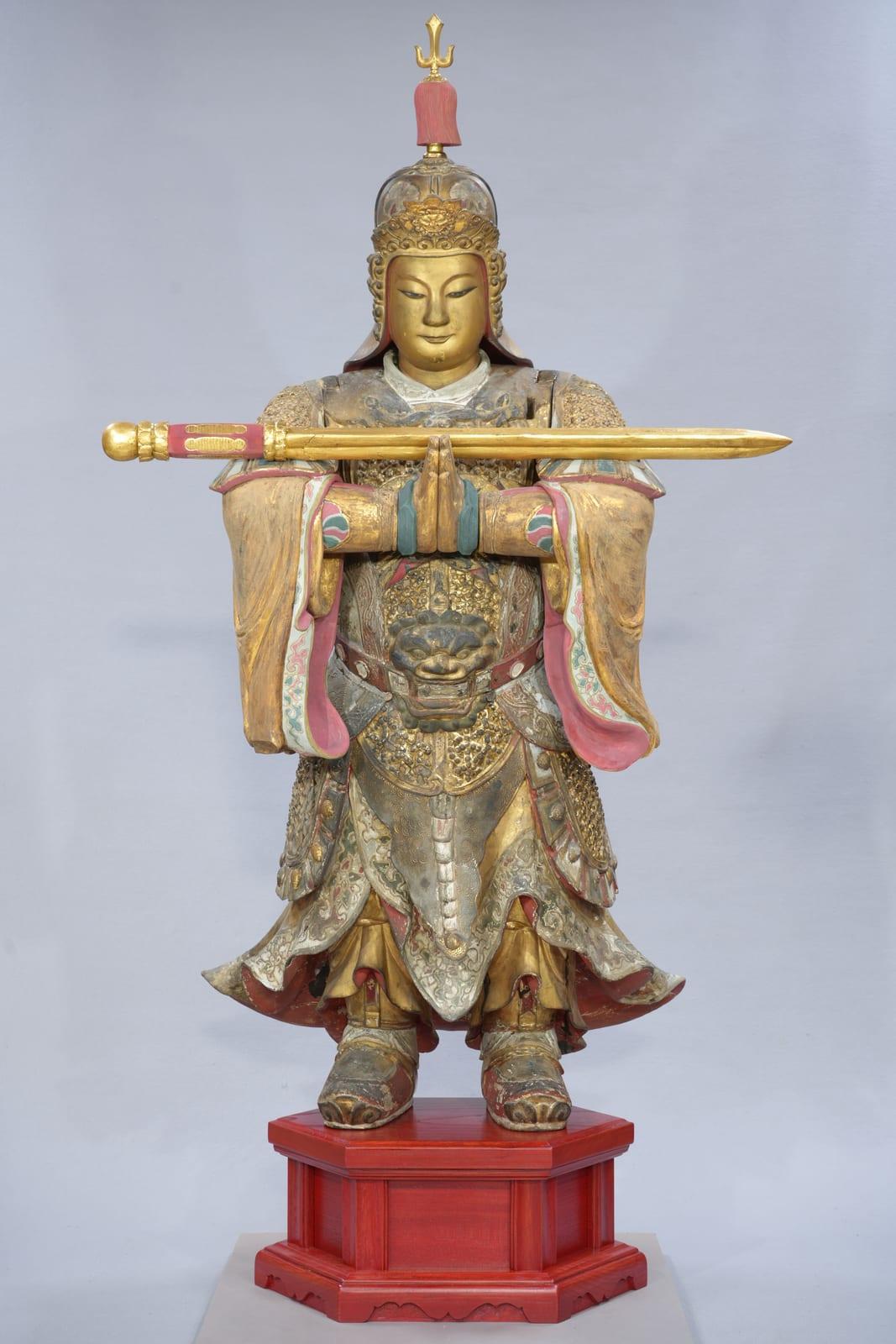
Idaten · The record of the restoration

A guardian deity who had lost both arms,
revived by learning from the head temple's statue.

Statues of Idaten in the Ōbaku style as large as this are rare even in Japan.It was made in Enpō 5 (1677) for Kōsaiji, the temple Lord Tsunayoshi founded in Tatebayashi.When Kōsaiji was abolished in Tenna 3 (1683), it was moved to Horinji through its ties with Zen Master Chōon Dōkai.For more than three hundred years since, though it had lost its arms, the ornament on its head, its jeweled club and its pedestal, it has gone on guarding the main hall.

  • 1677Made in Enpō 5For Lord Tsunayoshi's Kōsaiji,made by Kōyū of the Shichijō Bussho in Kyoto.
  • 4 partsWhat had been lostThe arms, the head ornament, the jeweled club and the pedestalwere made up, learning from the statue at the head temple, Manpukuji.
  • About 2 yearsRestoration at the studioIt left the temple in August, Reiwa 5 (2023),and its restoration was finished in March, Reiwa 7 (2025).
  1. June 22, Reiwa 4 (2022)

    Examining the statue at the temple

    The statue, which had lost its arms, its jeweled club and its pedestal, was examined in detail, and a plan for its repair was drawn up.

    The trunk of the armless statue of Idaten, laid down to be examined; the fine relief of its armor can be seen.
  2. August 23, Reiwa 5 (2023)

    To the studio

    The work was discussed with the officials in charge from Gunma Prefecture and the town of Chiyoda and with a member of Gunma Prefecture's council for cultural properties; the statue and its pedestal were packed and taken to the Kibi Conservation Studio for Cultural Objects in Saitama City.

  3. Fiscal year Reiwa 5 (2023)

    Securing the flaking coloring

    The dirt that had built up was brushed away, animal glue (nikawa) was run in beneath the lifting paint, and it was stuck down, held in place with paper.

    The skirt at the back of the statue: the painted tiger skin is being stuck down, held with small pieces of paper.
  4. Fiscal year Reiwa 5 (2023)

    From inside the statue, lost pieces

    When the things mice had carried into the hollow inside the statue were taken out, some of the statue's own pieces were found.

    Dry grass carried in by mice being taken out of the hollow inside the statue's leg.
  5. November 19, Reiwa 5 (2023)

    Studying the model statue at Manpukuji, the head temple

    It was decided to make up the lost parts using the statue of Idaten at Manpukuji, the head temple of the Ōbaku school, as a model. At Manpukuji, the shapes and structure of its details were recorded.

  6. Fiscal year Reiwa 5 (2023)

    Trying out the angle of the arms

    Based on the study at Manpukuji, trial arms, head ornament and jeweled club were made in foam, and the angle of the arms and how they fit together were examined again and again.

    The trial arms, joined in prayer and made in foam, fitted to the statue's body to check them.The white trial head ornament set on the head, and the white trial jeweled club.
  7. Fiscal year Reiwa 5 (2023)

    Keeping the coloring from when it was made

    Joints where the coloring was well preserved were deliberately not taken apart but reinforced with Japanese paper and animal glue. The small wooden beads stuck one by one onto the armor were also fixed again with glue.

    Glue being put in with a syringe among the small wooden beads that make the pattern on the chest of the armor.
  8. Reiwa 6 (2024)

    Carving the lost parts and matching their color

    From the shapes decided on in the trials, the arms, the head ornament, the jeweled club and the pedestal were carved anew and finished to match the original coloring.

  9. Reiwa 7 (2025)

    The restoration finished, the eye-opening ceremony

    The restoration was finished in March, and on November 8 the eye-opening ceremony for the restored statue was held.

Photographs and record: Kibi Conservation Studio for Cultural Objects, “Report on the Repair Work (Fiscal Year Reiwa 5)” (photos: Kibi Conservation Studio for Cultural Objects)

The course of the restoration

One statue at a time, back to their former appearance.

Restoring the coloring of Idaten's armor with a brush.Touching up the coloring of Idaten's face with a brush.
The restoration of Idaten: July, Reiwa 5 (2023) to March, Reiwa 7 (2025)
  1. Reiwa 4 (2022)Designated an Important Cultural Property by Gunma Prefecture
  2. Reiwa 5 (2023)The restoration of Idaten begins
  3. Reiwa 7 (2025)The eye-opening ceremony for the restored Idaten (November 8)
  4. Fiscal years Reiwa 8–10 (2026–2028)The restoration of Kakō Bosatsu (now)
  5. From fiscal year Reiwa 10 (2028)Daruma Daishi and Kinnara-ō Bosatsu (planned)
  6. Around 2032The unveiling of Miroku Bosatsu (planned)

Over about ten years from their designation, the statues are being restored one at a time.The first, Idaten, began with a detailed examination of the statue.With the statue of Idaten at Manpukuji as a model, its lost arms, jeweled club and pedestal were made up.

Kakō Bosatsu, now being restored

Buddhas awaiting restoration

Now being restored

The colors that were stripped away,
back to how they were.

Kakō Bosatsu is a guardian deity of the temple. Revered in China as a god of fire, he came to Japan together with the Ōbaku school.

Horinji's statue is a seated figure made in Enpō 5 (1677) by the Kyoto sculptor Kōyū for Lord Tsunayoshi's Kōsaiji.

As the second restoration after Idaten, a three-year repair has been under way since fiscal year Reiwa 8 (2026).

The statue of Kakō Bosatsu awaiting restoration, wearing a crown, with a third eye in its forehead. Its coloring has been stripped, and the black ground layer and the bare wood show.
Kakō Bosatsu before the repair. The hands and both legs are of wood put in later.
  • 130.7 cmHeight of the statueFrom the top of the crown to the base of the statue.He wears a crown and has a third eye in his forehead.
  • 2 statuesStatues of Kakō Bosatsu comparedHorinji's statue and the statue at Yamagishi Bishamondōin Sagae, Yamagata Prefecture, were studied.
  • 3 yearsThe repair, fiscal years Reiwa 8–10Returning the coloring, repairing the body,and making legs in proportion to the body.

The original coloring had been kept

When it was first made, the statue's wooden body was covered with cloth, over which lacquer and gold leaf were laid, and its patterns were drawn in thin raised lines.

Over the long years, the coloring of its surface had been stripped away, and its hands and both legs had been replaced with new wood.

With the prefecture's designation in Reiwa 4 (2022), it was decided to repair it as a cultural property. The coloring that was stripped away has been carefully kept, in fragments.

Learning from another statue of Kakō Bosatsu

In Reiwa 7 (2025), the restorers examined Horinji's statue and recorded its photographs, its measurements and the state of the stripped coloring.

Next, they examined the statue of Kakō Bosatsu at Yamagishi Bishamondō in Sagae, Yamagata Prefecture (a cultural property designated by the city of Sagae). It was originally the statue of Bairyūji, a temple founded by Master Chōon, and it sits on a chair.

Its whole body is covered in gold leaf; dragons and hōsōge flowers are drawn in high raised lines as fine as thread, and mother-of-pearl is set in the dragons' eyes. It gives clues for working out the missing hands and patterns.

How Ōbaku statues spread in Japan

  1. From 1660The Chinese sculptor Han Dōsei (Fan Daosheng) makes Ōbaku statues in Nagasaki
  2. From 1663Han Dōsei and the Shichijō sculptors of Kyoto make the statues of Manpukuji
  3. Around 1677Kōyū of the Shichijō sculptors and others make the statues for Lord Tsunayoshi's Kōsaiji (Horinji's statues)
  4. From the 1680sWorkshops in Edo begin to make Ōbaku statues
  5. From 1695They reach the Tōhoku region. The statue of Bairyūji (now at Yamagishi Bishamondō) has a form whose foreign air has softened

From the restorers' study. Horinji's statue is an early Ōbaku statue, by sculptors who had helped make the statues of Manpukuji.

The thinking behind the repair

  1. All the original coloring that remains is to go back to its original place.
  2. The stripped form of today is regarded as “a damaged state,” and the cloth is not to be laid anew.
  3. The legs added later are to be taken off and kept separately, and legs in proportion to the body made up (the same thinking as with Idaten's arms).

The restoration is by the Kibi Conservation Studio for Cultural Objects. Its policy is discussed by the “Expert Committee for the Survey and Restoration of the Ōbaku-School Sculptures of Horinji, Chiyoda,” made up of specialists in cultural properties from the prefecture and the town.

The course of the repair

  1. Fiscal year Reiwa 7 (2025)DoneExamining Horinji's statue and the statue at Yamagishi Bishamondō
  2. Fiscal year Reiwa 8 (2026)NowReinforcing the fragments of stripped coloring and finding where they belong. Drafting plans to restore the legs
  3. Fiscal year Reiwa 9 (2027)Repairing the body and putting the coloring back in its place. Making up what is missing
  4. Fiscal year Reiwa 10 (2028)Making up the legs, finishing the surface, and returning to the temple

The work now: September, Reiwa 8 (2026)

The stripped coloring turned out to be broken into far smaller pieces than expected. The largest are about the size of an A4 sheet; most are the size of a fingernail.

All of them have now been backed, and with the photographs taken before the repair as clues, the place of each piece is being sought one by one. For the head, many of the large fragments have been found.

The patterns that can be clearly seen in the photographs have been drawn again, and the parts that cannot be made out will be made up with other statues as models.

Together

Carrying the Buddhas
into the next 300 years.

Restoration takes a long time, and it is costly.The restoration of Idaten alone took about two years.The proceeds from the papercut goshuin of Idaten go to the restoration of the statues.